2026 February Stewardship Advocate
45Z “Clean Fuel” Tax Credit
After more than a year of uncertainty about the 45Z credit, the Treasury finally released guidance on February 4, 2026. The Section 45Z Clean Fuel Production Credit is a U.S. federal tax incentive for domestic producers of low-emission, low-carbon transportation fuels (e.g., ethanol, Sustainable Aviation Fuel or SAF, renewable diesel) sold between January 1, 2025 and December 31, 2029. The 2029 end date is two years later than the original 45Z language released in 2024. Fuel producers such as ethanol plants can receive up to $1.00 per gallon of ethanol designated for cars, trucks and other non-aviation vehicles. For the purposes of this article, clean fuel producers are ethanol plants.
Main Elements of the 45Z Tax Credit Guidance
- Ethanol producers must be registered with IRS.
- Feedstocks must be sourced from the US, Mexico or Canada. Foreign feedstocks are not allowed.
- Maximum 45Z tax credits are allowed only if prevailing wages and apprenticeship requirements are met.
- To receive 45Z tax credit, the ethanol produced by a plant must have a lifecycle greenhouse gas emissions rate of no more than 50 kg of CO2e per mmBTU. This value is also considered the carbon intensity score.
- The 45Z tax credit is adjusted annually for inflation.
Calculating the 45Z Tax Credit
It is unclear at this time what calculator will be used to compute the CI score of the ethanol produced by plant or grain produced by farmers. What is known is that the calculator for ethanol will be based on the GREET (Greenhouse gases, Regulated Emissions, and Energy use in Technologies) model. This model is used extensively in the U.S. to determine eligibility for tax credits under the Inflation Reduction Act, particularly for clean fuels. As mentioned above, to qualify for the 45Z tax credit, fuel produced by an ethanol plant must have a CI score below 50. By statute, the CI score is rounded to the nearest “5” to calculate the credit. The tax credit is calculated as 2₵ per gallon for each point of CI reduction from the baseline of 50. See Table 1 for various CI scores and the associated tax credit per gallon of ethanol.
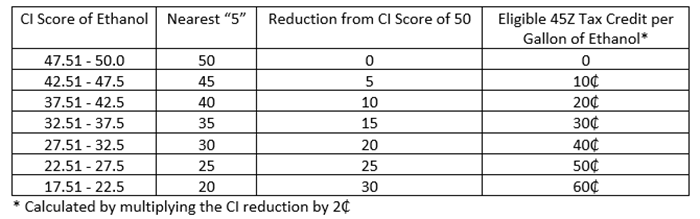
Table 1. Examples of Ethanol Carbon Intensity Scores and Corresponding 45Z Tax Credits.
How Can Iowa Farmers Benefit from 45Z?
A logical question is if 45Z tax credits go to a fuel producer (i.e., ethanol plant), what is the benefit to an Iowa corn farmer? University of Illinois Ag Economist Scott Irwin answers the question by pointing out two potential future benefits for farmers, including:
- In the future, it may be possible for farmers delivering lower CI score grain to benefit by helping the plant lower the CI score of the ethanol produced. As shown in Table 1, lowering the CI score of ethanol garners a higher 45Z tax credit for ethanol plants. Once the final details are codified and tax credits are available, an ethanol plant may choose to share its tax credit with corn farmers that deliver low carbon corn.
- A more attractive basis, because as plants produce more ethanol, they will need more corn to meet their production capacity.
Advice for Corn Farmers
Once the treasury guidance is finalized and the USDA and DOE release a CI calculator for scoring corn production practices, farmers that deliver low CI grain should communicate directly with their local plant to understand what tax-credit-sharing program that the plant is planning or has in place. While CI scores apply to the fuel for tax credits, farmers can also calculate their CI scores for the corn they produce. Factors to reduce on-farm CI scores include:
- Higher grain yield
- Reduced tillage
- Planting cover crops
- Lower fertilizer rates, especially nitrogen
- Applying manure
Concluding Thoughts
The 45Z tax credit has the potential to benefit both ethanol plants and farmers. The guidance released by the treasury in early February is a good first step. However, there is still uncertainty about the CI models that will be used, and how verification, auditing and record-keeping will be addressed. The details for these activities should be released soon and we will keep you informed when they are.
Source: https://www.agweb.com/news/business/two-ways-45z-will-help-farmers-capture-dollars
Latest Information
Secretary Naig Urges Congress to Find Agreement to Make Year-Round E15 Available Nationwide
Secretary Naig Recognizes Conservation Leaders at 2026 Iowa Agribusiness Showcase and Conference
Saturated buffer performance under alternative weir settings: Implications for design and management
Experts examine how tile in farm fields impacts water movement
USMCA a Powerful Economic Engine for Rural America, Report Shows
Why Nitrate Levels Are High This Winter in the Raccoon River
Avoid These 6 Mistakes When Taking Soil Health Samples
Farmer to Farmer: Dave Vandenberg
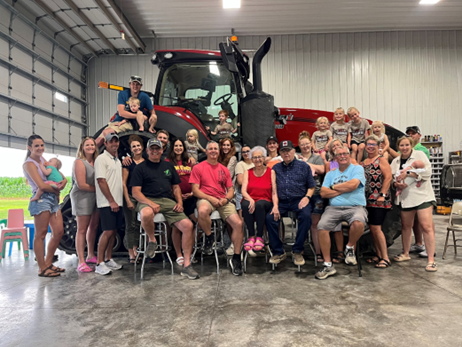
Vandenberg Farm operates in Lee County near Donnellson, Iowa. They also farm ground in Van Buren and Henry County. Dave and wife Michelle manage the third-generation farm along with his brother Brad and father Bert.
When Dave started farming with his father, they operated a farrow to finish hog operation and row-cropped corn, soybeans and wheat. “We started helping with the livestock at a very early age,” shared Dave. “In the farrowing operation, we bed pens with ground corn cobs by the bucket. It was my brother and my job to carry buckets of ground corn cobs to the farrowing pens as our father and hired man cleaned the pens. We later sold the sows and bought early wean pigs from a local co-op. We got out of the livestock business about 10 years ago to focus on our crops.”
Dave started helping with the crops when he was 14 years old, saying, “I did some tillage and planted soybeans with a drill. At that time, we were in a corn-soybean rotation with a little wheat for a place to haul manure. This was standard procedure for most of the farms around our area back then.”
Their current crop rotation is 50:50 corn and soybeans. They plant their corn at a population of 34,000 seeds per acre. They are conventional till on part of their acres and no-till on marginal acres. Their fertility program consists of a fall application of 150-180 pounds per acre depending on the field and then follow up with side-dressing 60 pounds in June. They are contemplating trying cover crops in the future on their rolling ground to minimize erosion.
In addition to his full-time job on the farm, Dave finds time to give back to his local county and district corn boards as well as serving as the District 9 Iowa Corn Promotion Board Director. He is committed to helping to grow demand of corn, saying “We are very good at growing corn in Iowa, but we need to find more markets for our crops. Hopefully, the adoption of year-round E15 will happen soon to not only help farmers but also to provide a lower carbon, less expensive choice at the gas pump for drivers. I want to help Iowa Corn and our producers find new markets to grind more corn while looking for ways to reduce our input costs.”
Upcoming Events:
Throughout March: Events – Iowa Learning Farms; Webinars and field days.
March 3: Bardole Family Shares Conservation Insight at Shop Talk; 9:00 am; 2074 285th St. Rippey, Iowa.
March 10: Paul Kassel and Will Jones Share Strip- and No-Till Insights; 9:30 am; 4430 US-71 Sioux Rapids.
March 12: Benefits and Implementation of Drainage Water Recycling; 1:00; Webinar.
Share This Article


Related Articles
The January 2026 Stewardship Advocate discusses the methods and technologies available to help farmers with nutrient management.
The December 2025 Stewardship Advocate discusses the INREC practices survey results.